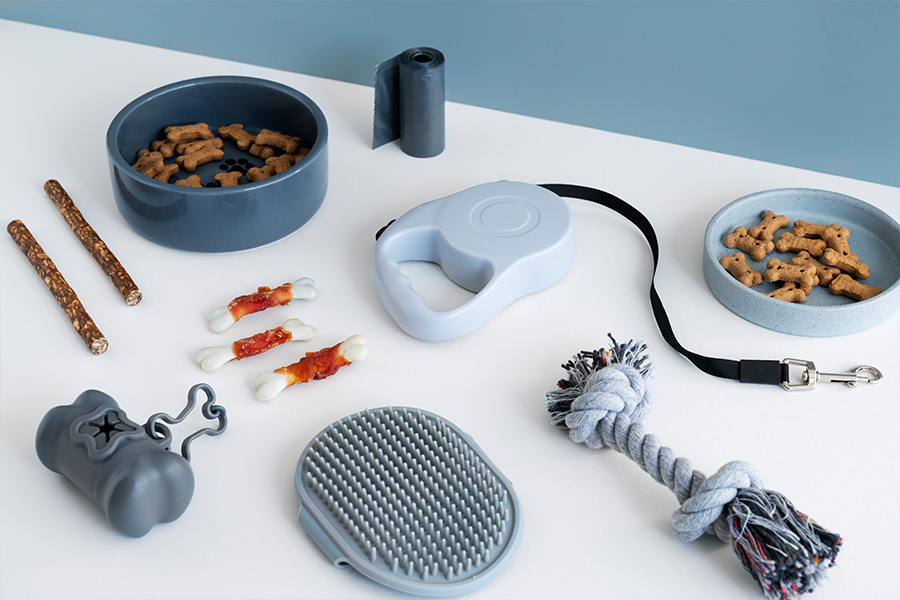
In August 2025, the U.S. Consumer Product Safety Commission (CPSC) recalled roughly 15,000 LED pet toy balls containing button batteries, after the toys could break on impact, exposing the batteries and leaving them within reach of young children. Less than a year later, more than 50,000 pet laser toys were recalled over insecure battery compartments. Pet product safety risks are never limited to the pet itself — they extend to the children and families who come into contact with these products.
Meanwhile, the global pet products market keeps expanding. According to research from the East China Fair (ECF), the market is projected to reach roughly US$248.7 billion in 2025 and US$369.9 billion by 2030, at a compound annual growth rate of over 8%. A bigger market means tougher competition — and a single batch-level quality failure can wipe out the profit of an entire order.
This guide takes a category-wide view of pet product inspection: what to check for each product category, how to apply the five key checkpoints, how to sample scientifically with AQL, and how common defects are classified.
Why Pet Products Are One of the Hardest Categories to Inspect
Pet products are unique: the user is the pet, the buyer is the household, and the safety risk can reach children. Inspection therefore cannot stop at “will the pet like it” — it has to satisfy multiple standards at once.
| Risk dimension | Why it matters |
|---|---|
| Material safety | Pets chew and lick products constantly, so harmful substances can enter their bodies by mouth. Plastic odor, heavy metals and excess plasticizers are the top causes of overseas negative reviews and returns. |
| Dual safety responsibility | Products with button batteries or small parts that children could touch or swallow can trigger regulatory recalls — a compliance incident, not just a quality one. |
| Durability and function | Chew toys must withstand biting, leashes must resist pulling, and smart devices must be waterproof and electrically safe. A functional failure can directly injure the pet. |
| Dimensions and tolerances | Inconsistent feeding capacity, chest sizes or nozzle tolerances lead to batch-level complaints about products not matching their stated specs. |
Risk profiles differ significantly by category, so inspection must be tailored accordingly:
| Category | Typical products | Core risks | Key checks |
|---|---|---|---|
| Food-contact items | Food bowls, slow feeders, water fountains | Material migration, odor, burrs | Odor test, edge chamfering, drop test, review of material compliance documents |
| Chew and bite toys | Teething toys, rubber toys | Tearing and ingestion, small-part detachment | Tensile/tear test, size and attachment security, bite resistance |
| Restraints and wearables | Harnesses, collars, leashes | Breakage, injury/choking risk, corroding hardware | Tensile strength, seam strength, salt spray on metal parts, size grading |
| Home and habitat | Pet beds, litter boxes, playpens | Formaldehyde, color bleeding, structural collapse | Fabric formaldehyde, colorfastness, frame load capacity, anti-slip properties |
| Electronic and smart devices | Smart feeders, water dispensers | Electrical safety, battery compartment, waterproofing | Battery compartment security, electrical safety, IP rating |
Pre-Shipment Inspection Checklist: The 5 Key Checkpoints
Third-party inspection follows AQL sampling and systematically covers five dimensions:
- Appearance and workmanship: surface oil, scratches, color deviation, shrinkage, flash and burrs; print/transfer adhesion (fingernail scratch test)
- Materials and safety: odor assessment (ambient and slightly warmed conditions), sharpness of edges and chamfers, small-part/attachment security (pull test); items at risk of heavy metals or plasticizers are sent to a lab for verification; for food-contact or battery-powered products, request target-market compliance documents from the supplier first (e.g., FDA/LFGB reports, GPSR responsible person information) and have the inspector verify labels and warning statements on site
- Structure and function: dimensional tolerance checks (caliper/tape measure), drop test (simulating transit and use), tensile/bite tests (per category), adhesion of anti-slip parts, power-on and battery compartment checks for electronics
- Packaging and labeling: condition of the retail box/blister, warning statements and compliance marks, scannable barcodes, correct instruction manual language
- Quantity and shipping marks: carton count and quantity checked against the packing list, outer carton marks matching documents, pallet and container loading supervision
Common Defect Classification for Pet Product Inspection
| # | Defect | Typical grade | Common causes |
|---|---|---|---|
| 1 | Pungent plastic/silicone odor | Major–Critical | Recycled material or excessive additives; send to lab for confirmation |
| 2 | Sharp burrs and edges | Critical (food-contact) | Insufficient mold polishing, missing post-processing |
| 3 | Detached small parts/attachments | Critical | Unstable bonding or welding process |
| 4 | Insecure battery compartment, missing warnings | Critical | Design or assembly defect |
| 5 | Size/capacity deviating from spec | Major | Mold wear, uncontrolled shrinkage |
| 6 | Insufficient tensile strength (leashes/wearables) | Major | Reduced seam strength or downgraded hardware |
| 7 | Color bleeding, print peeling | Minor–Major | Poor ink/dye adhesion |
| 8 | Damaged packaging, missing label info | Major | Cost-cutting on packaging, weak QC awareness |
Zero tolerance for critical defects: any issue involving pet or child safety fails the entire batch; rework and re-inspection are required before shipment.
Sample Scientifically with AQL: No Missed Defects, No Over-Inspection
100% inspection of the full lot is impractical. The industry standard is ISO 2859-1, General Inspection Level II, typically with AQL 2.5 (major defects) / 4.0 (minor defects) and zero tolerance for critical defects:

| Batch size (units) | Sample size | AQL 2.5 (Ac/Re) | AQL 4.0 (Ac/Re) |
|---|---|---|---|
| 281–500 | 50 | 3/4 | 5/6 |
| 501–1,200 | 80 | 5/6 | 7/8 |
| 1,201–3,200 | 125 | 7/8 | 10/11 |
| 3,201–10,000 | 200 | 10/11 | 14/15 |
Note: safety-related checkpoints (burrs, attachment security, battery compartments) should never rely on AQL math alone — inspectors normally run functional checks on every sampled unit.
FAQ
How is pet product inspection different from inspection of general consumer goods?
Pet products must satisfy dual standards — pet safety plus family safety. Inspectors focus on material safety (for food-contact items), attachment security (to prevent accidental ingestion), and battery compartment design on battery-powered products — checks that general consumer goods inspection may not cover.
When should pet product inspection be scheduled?
Pre-shipment inspection (PSI) is recommended: sampling is most representative when production is 100% complete and at least 80% of the goods are packed. For new factories or new product categories, add an initial production check (IPC) and during-production inspection (DPI).
What if batch-level quality issues are found?
The inspector records the defects with photo evidence in the report. The buyer can then require the factory to rework, re-sort or replace materials, followed by re-inspection before shipment — fixing problems at the factory is always the cheapest option.
What can an inspection report tell you?
A standard report states the sample size per batch, defect classification and counts per AQL, on-site photos, and corrective recommendations. Buyers can use it to decide whether to release, rework or reject a shipment — and it also serves as leverage in negotiations with the factory.
Keep Quality Risk at the Factory — Not in Your Overseas Warehouse
If pet products ship with defects, you risk marketplace delisting, overseas returns, or even regulatory recalls. Only when material, structural and functional risks are fully screened before shipment is your supply chain truly under control.
Inspector Online has 20 years of third-party inspection experience, a network of 3,000+ professional inspectors across major manufacturing bases worldwide, 30-minute response times and electronic inspection reports within 4 hours — covering the full process from initial production check, during-production inspection and pre-shipment inspection to container loading supervision.