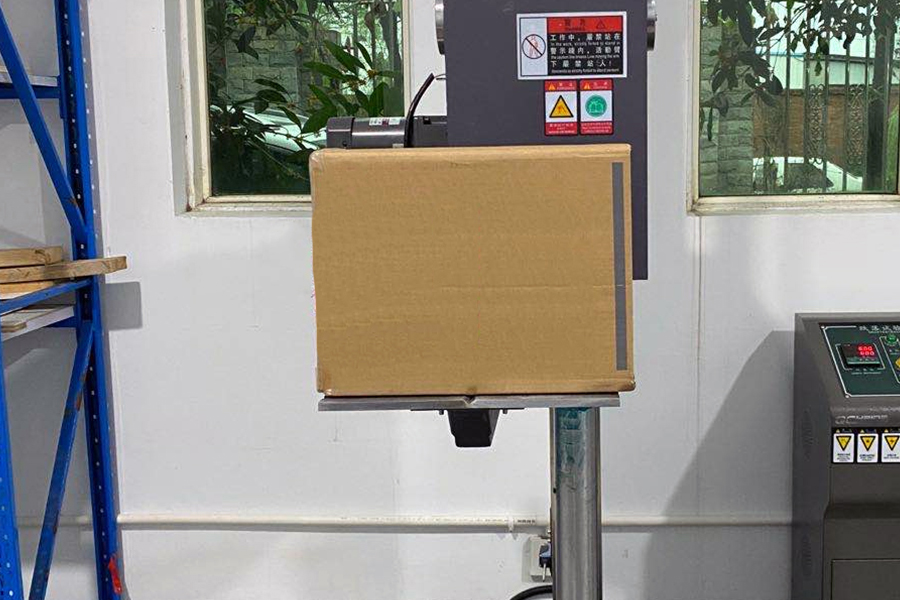
Industry studies consistently show that roughly 70% of in-transit damage occurs during warehouse handling and last-mile delivery; by industry estimates, global logistics losses from freight damage run as high as US$50–60 billion per year. For exporters, goods leaving the factory intact is no guarantee they arrive intact—drops, throws, and rough handling are the most common and most destructive shock events in the supply chain. In May 2026, the U.S. CPSC announced a recall of approximately 312,100 EEMB lithium coin-cell batteries solely because the packaging failed child-resistant opening requirements (Reese’s Law), with projected refunds near US$1.9 million. A single lapse in packaging can cost millions.
The drop test is the core method for verifying whether “transit packaging can survive an accidental fall.” It simulates free-fall during handling, sorting, and loading, and evaluates the package’s ability to protect its contents. This article systematically reviews the three leading drop-test standards, height grading, drop sequence, pass/fail criteria, and common defects—helping buyers catch transit risk at the factory before shipment.
1. The Three Leading Drop-Test Standards
There is no single “one-size-fits-all” drop test; the right standard is chosen by product type, target market, and mode of transport. The three most common systems in export inspection are:
| Standard | Scope | Key Feature | Issuing Body |
|---|---|---|---|
| ISTA 3A | Individual parcels ≤70 kg (e-commerce) | Simulates actual multimodal transport; includes conditioning, vibration, and drop | International Safe Transit Association (ISTA, founded 1948) |
| ASTM D5276-19 (2023) | Loaded containers ≤50 kg (110 lb) | General free-fall method standard; applies to cartons / cylinders / bags | ASTM International |
| GB/T 4857.5-2022 | Transport packages ≤100 kg | China national standard; equivalent to ISO 2248:1985 | Standardization Administration of China |
How they relate: ISTA 3A provides a specific weight-to-height table; ASTM D5276 defines the test “method” (free fall, impact surface, orientation sequence), with height set by product spec or contract; GB/T 4857.5 is China’s national recommended standard, with drop height selected by mode of transport (sea / land-air). All three systems align closely on the “corner-edge-face” drop sequence.
ASTM D5276-19(2023) Related Links
2. How Drop Height Is Determined: Weight Grading
Core principle: drop height is inversely proportional to package weight—lighter, smaller items are more likely to be thrown on sorting lines, so their drop probability and relative height are actually higher; heavy cargo is mostly handled by machinery, so its drop height is lower.
Taking the most widely used ISTA 3A as an example, the drop height for a single parcel by gross weight is graded as follows:
| Package Weight | Drop Height | Note |
|---|---|---|
| ≤ 9.1 kg | 762 mm (30 in) | Lightest; highest throw risk |
| 9.1 – 18.2 kg | 610 mm (24 in) | |
| 18.2 – 27.3 kg | 457 mm (18 in) | |
| 27.3 – 45.5 kg | 305 mm (12 in) | |
| 45.5 – 70 kg | 203 mm (8 in) | Heavy cargo; mostly machine-handled |
GB/T 4857.5 instead selects a base height by mode of transport: 800 mm base for sea freight, 500 mm for road / rail / air, with adjustment allowed within the recommended 50–1500 mm range based on product risk. Always confirm which standard the buyer specifies before inspection to avoid invalidating the test with the wrong height.
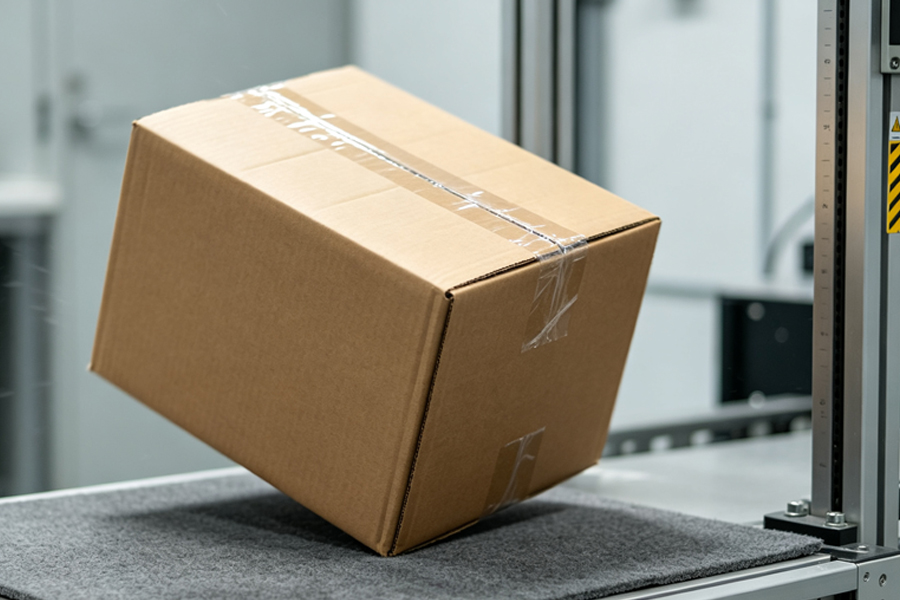
3. Drop Orientation: One Corner, Three Edges, Six Faces
A standard drop is not “just dropped a few times at random”—it follows a strict sequence of 1 corner + 3 edges + 6 faces = 10 drops total, covering the package’s every vulnerable orientation:
- 1 corner: the weakest corner through the package’s center-of-gravity line (typically where weak structures meet); dropped vertically 1 time.
- 3 edges: the three edges adjoining that corner, each dropped 1 time.
- 6 faces: each of the six faces dropped 1 time (the base is dropped last).
This sequence also appears in ASTM D5276 (corner → edge → face progression) and GB/T 4857.5. The machine’s impact surface must be a flat, rigid plane—concrete or a steel plate no thinner than 13 mm, with a mass at least 50× that of the heaviest specimen—so the shock energy is fully absorbed by the sample. At release, the sample must have no initial velocity, no rotation, and no lateral force.
4. Drop-Test Procedure and Pass Criteria for Packages
The standard procedure has four steps: sample prep → conditioning → 10 sequential drops → comprehensive evaluation.
- Sample preparation: use the complete package in actual shipping condition (including inner liner, cushioning, and product); no substitutes; seal as it will ship, allowing adhesive / tape cure time.
- Conditioning: temperature and humidity conditioning per standard (e.g., ISTA 3A requires 23°C ±2°C / 50% ±5% RH for 72 hours) to simulate transit environment.
- Sequential drops: strictly complete the 10 free-fall drops in “corner-edge-face” order, recording height, orientation, and impact behavior each time.
- Comprehensive evaluation: open the package immediately after drops and inspect packaging and product.
| Evaluation Dimension | Pass Criteria | Common Failure |
|---|---|---|
| Outer packaging integrity | No punctures, no severe deformation, seal intact | Carton rupture, tape delamination, structural collapse |
| Contents function | Product works normally, undamaged, usable | Electronics failure, glass/ceramic breakage, parts detached |
| Cushioning structure | Inner liner / EPE / edge protector not failed | Cushion crushed, product shifted and collided |
5. Product Drop vs. Package Drop (Common Defects)
It is important to distinguish two types of “drop”:
- Package drop (transit packaging test): tests “whether the box protects the product,” based on ISTA 3A / GB/T 4857.5, focused on the outer carton and cushioning.
- Product drop / abuse test: tests “whether the product itself survives falls,” a product performance test. For example, toys are dropped from 93 cm per ASTM F963, and electronics undergo torque / tension / abuse testing.
The most frequent package-drop defects found in inspection: ① insufficient carton grammage, single-wall corrugated shipped bare; ② missing or crushed cushioning, excessive gap between product and wall; ③ heavy cargo without edge protectors / strapping, edges hit first and rupture; ④ case-sealing tape loses adhesion at low temperature and opens in transit.
In May 2026, the U.S. CPSC issued an emergency recall: approximately 312,100 EEMB lithium coin-cell batteries were pulled from all channels because the packaging failed child-resistant opening requirements (violating Reese’s Law / 16 CFR Part 1700). Projected refunds reached nearly US$1.9 million, while compliant packaging would have cost only about US$0.30 per unit. The product itself had no quality defect—a single packaging lapse wiped out three years of sales overnight. This shows: packaging is not an accessory, but the lifeline of export compliance and transit safety.
A cross-border e-commerce order of Bluetooth earbuds used an original single-wall carton with the bare unit inside. After the ISTA 3A (≤9.1 kg, 762 mm) “corner-edge-face” drop sequence, the housing cracked and buttons failed. The inspector judged it Failed and recommended switching to a double-wall carton + EPE liner + individual blister tray. On retest, all 10 drops left the product fully functional and the order shipped successfully. (Note: this scenario is an illustrative example of a typical inspection case, used to explain the test logic.)
Drop-Test Quick-Reference Checklist
| Dimension | Key Point | Criteria / Standard Value |
|---|---|---|
| Standard | ISTA 3A / ASTM D5276 / GB/T 4857.5 | Select by market and mode |
| Drop height | Graded by package weight (lighter = higher) | ISTA 3A: 762 / 610 / 457 / 305 / 203 mm |
| Drop sequence | Corner-edge-face | 10 drops total |
| Impact surface | Concrete or ≥13 mm steel plate, mass ≥50× specimen | Rigid, level, non-deforming |
| Pass criteria | Package intact + product functional + cushion effective | No puncture, no failure, no shift |
| Common defects | Weak corrugation / crushed cushion / missing edge guard / tape delamination | Causes arrival damage and returns |