In September 2025, the U.S. Consumer Product Safety Commission (CPSC) announced a recall of 11,200 online-sold dressers due to tip-over and entrapment hazards when not anchored to walls(Reference Link), which pose severe injury or death risks to children. The products failed to meet the requirements of ASTM F2057, the U.S. standard for anti-tip performance of clothing storage units. In the same period, the EU’s RAPEX rapid alert system issued over 80 notifications for furniture products, primarily linked to structural instability and sharp edge hazards(Reference Link).
Furniture is one of the largest and most structurally complex product categories in global trade. Defects often lie not in raw materials, but in three easily overlooked links: structural joints, surface coatings, and transport packaging. This article systematically breaks down the core furniture inspection workflow, structural strength testing protocols, surface finish verification, and packaging inspection criteria, helping importers and buyers mitigate risks at the factory before shipment.
1. Core Standard Systems for Furniture Inspection
Standard selection depends on the target market and product type. Before inspection, it is critical to confirm the product category and destination country to apply the correct compliance framework.
| Target Market | Key Standards | Applicable Products | Key Compliance Focus |
|---|---|---|---|
| US (Office Furniture) | BIFMA X5.1 / X5.4 / X5.5 / X5.6 | Office chairs, public seating, office desks, storage units | Structural strength, fatigue durability, stability |
| US (Residential Furniture) | ASTM F2057 / ASTM F3096 | Clothing storage units, surface coatings | Anti-tip performance, coating adhesion |
| European Union | EN 12520 / EN 12521 / EN 14749 | Seating, tables, storage cabinets | Strength, durability, safety |
| Packaging & Transport | ISTA 3A / ISTA 3B | All packaged furniture units | Drop, vibration, impact, stacking performance |
In practice, third-party inspection companies execute tests according to the buyer’s specified market standards. For US-bound furniture, priorities include the BIFMA series and ASTM F2057 anti-tip requirements; for EU exports, compliance with EN 12520/EN 12521 strength and durability requirements is mandatory.
2. Visual & Dimensional Inspection: The First Quality Gate
Visual inspection follows the AQL sampling standard (GB/T 2828.1, equivalent to ISO 2859-1). For standard furniture orders, General Inspection Level II is applied, with AQL 2.5 for major defects and AQL 4.0 for minor defects. For an order of 500 units, for example, 50 pieces are sampled, with an acceptance number of 3 and rejection number of 4 for major defects.
Core Visual Inspection Items
- Surface defects: Check for runs, orange peel, particles, or missed coverage on paint finishes; blistering, cracking, or color variation on wood veneers; rust, oxidation, or plating peeling on metal components.
- Assembly quality: Verify tight, gap-free joints between components; fully tightened screws with no stripping; smooth, noise-free operation of drawer slides; proper functioning of door hinges through full range of motion.
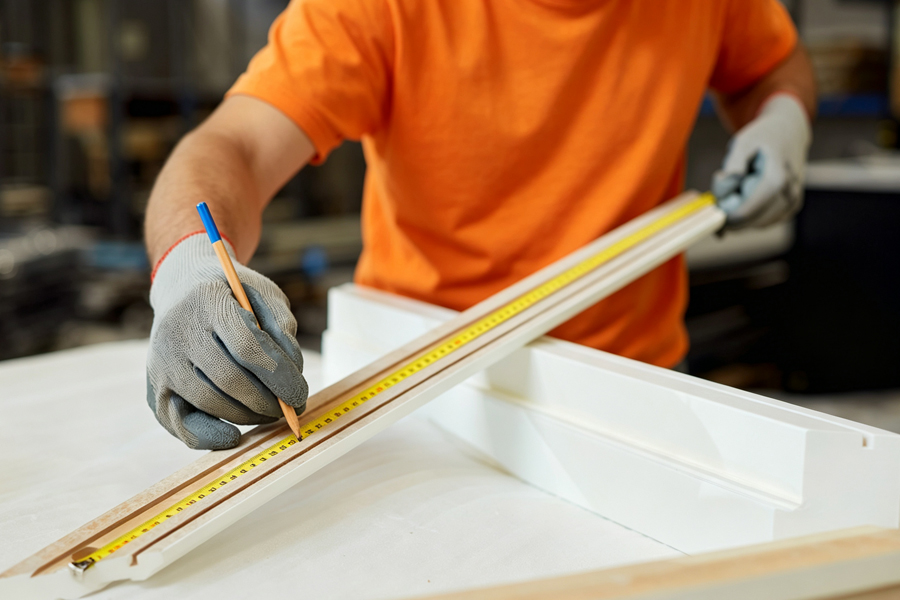
- Dimensional tolerance: Length/width/height/thickness tolerances are typically controlled at ±3mm; critical assembly dimensions (e.g., gap between drawer and cabinet) are held to ±1mm.
- Color consistency: Evaluate color uniformity across the production batch against the approved sample. Standard orders require a gray scale rating of Grade 4 or above (per GB/T 250), while premium orders require ΔE ≤ 1.0.
Inspection Case Study
In 2025, a buyer shipped a batch of solid wood dining chairs from Foshan to Australia, only to receive customer complaints of inconsistent walnut finish across the batch, with pieces appearing to come from two separate production runs. A root cause review found paint mixing ratio deviations during shift changes on the factory’s spray line, resulting in a gray scale rating of only Grade 3 between batches.
This issue could have been caught at the factory if sampling had compared color across production shifts. The batch required full re-spraying, delaying delivery by 20 days.
3. Structural Strength Testing: The Core of Furniture Inspection
Structural integrity is the safety lifeline of furniture products. Below are four mandatory structural tests, performed in accordance with target market standards.
3.1 Static Load Testing
Simulates load-bearing capacity under normal use conditions. Test methods and load values vary by product type and standard requirements.
- Seating (EN 12520 / BIFMA X5.1): Apply 1300N (EN standard) or 1.5x the rated load (BIFMA) to the seat surface, held for 10 cycles × 10 seconds each. Pass criteria: No structural damage, no permanent deformation, no loose fasteners.
- Table tops (EN 12521): Apply 1000N vertical force to the center of the table top, and 350N vertical force to the table edge, each for 10 cycles × 10 seconds. Pass criteria: No fracture, deflection within allowable limits.
- Shelves (EN 14749): Distribute the rated load (typically 30–50kg) evenly across the shelf for 7 days. Pass criteria: Deflection ≤ 1/200 of the span; permanent deformation ≤ 1mm after unloading.
3.2 Impact Testing
Simulates sudden force scenarios to verify structural impact resistance.
- Seat impact (BIFMA X5.1): A 25kg sandbag is dropped freely from a height of 180mm onto the seat surface, 1 impact cycle. Pass criteria: No cracking, no adhesive failure, full functional integrity.
- Backrest impact (EN 12520): Apply 190N horizontal impact force to the top of the backrest. Pass criteria: No structural damage, no loose connections.
3.3 Fatigue & Durability Testing
Simulates long-term use to validate product lifespan. This is the key test for identifying structural design flaws.
| Test Item | Standard | Cycle Count | Pass Criteria |
|---|---|---|---|
| Seat compression fatigue | BIFMA X5.1 | 100,000 cycles | Normal function, no abnormal wear |
| Drawer opening/closing fatigue | EN 14749 / BIFMA X5.6 | 50,000 cycles | Smooth slide operation, no disengagement |
| Door hinge opening/closing fatigue | EN 14749 | 50,000 cycles | No loose hinges, no door sagging |
| Shelf load durability | EN 14749 | 10,000 load/unload cycles | No excessive permanent deformation |
3.4 Stability Testing
Stability testing is critical to preventing tip-over injuries, especially for children’s furniture and storage cabinets.
- Anti-tip test (ASTM F2057): With all drawers of the empty cabinet fully extended, apply 50N downward force to the front edge of the top drawer. Pass criteria: Cabinet does not tip over. This failure is the leading cause of CPSC furniture recalls in 2025.
- Seat forward stability (EN 12520): Apply 600N downward force to the front edge of the seat; the chair must not tip forward.
- 10° slope test: Place furniture on a 10° inclined platform; no sliding or tipping allowed. Applicable to wheeled furniture and floor lamps.
Inspection Case Study
A brand exported a batch of three-drawer chests from Ningbo to the US. During ASTM F2057 anti-tip testing, the inspector found the empty cabinet tipped forward when 50N force was applied to the top drawer with all drawers open. The root cause was an overly thin cabinet back panel (only 6mm MDF) and no included wall anchoring hardware.
The batch was failed before shipment, avoiding a potential mandatory CPSC recall upon arrival in the US. Corrective actions: Thickened back panel to 9mm, included standard L-shaped anti-tip brackets, and added warning labels on packaging.
4. Surface Treatment Verification
Surface treatment affects not only aesthetics but also product durability and regulatory compliance.
Coating & Paint Inspection
- Adhesion test (cross-cut method, ISO 2409): Score a 6×6 grid on the coating surface with a cross-cut tester, apply 3M adhesive tape and peel off. A rating of Grade 1 or better is considered acceptable (coating peeling area ≤ 5%).
- Hardness test (pencil hardness method): Test coating surface with pencils of varying hardness. Standard furniture requires ≥2H; table tops require ≥3H.
- Color difference: Compare against approved sample using a colorimeter to measure ΔE value. Standard orders require ΔE ≤ 1.5; premium orders require ΔE ≤ 1.0.
- Gloss: Measure with a gloss meter; deviation from approved sample ≤ 5 GU (at 60° angle).
Wood Veneer & Laminate Inspection
- Check for blistering, cracking, or edge lifting on veneers
- Consistent grain direction, with splicing gaps ≤ 0.2mm
- Veneer thickness ≥ 0.6mm (thinner veneers are prone to glue bleed-through and wear)
- No glue overflow or gaps between edge banding and panel substrate
Hardware Component Inspection
- Verify material and specifications of handles, hinges, and slides match the product specification sheet
- Salt spray test for metal parts (if applicable): 24–48 hours with no rust formation
- Operation smoothness: No jamming or abnormal noise when opening/closing fully loaded drawers
- Proper function of damping systems (e.g., soft-close hinges, push-to-open slides)
5. Packaging & Transport Testing
Furniture has the highest transport damage rate among all product categories, making packaging validation critical.
ISTA 3A (Single Parcel Shipping)
- Pre-conditioning: Temperature and humidity conditioning for 72 hours (23°C ±2°C, 50% ±5% RH)
- Drop test: Drop height determined by package weight (typically 300–600mm), 10 drops total following the “one corner, three edges, six faces” sequence
- Vibration test: 60 minutes of random vibration simulating over-the-road truck transport
- Impact test: Incline impact simulating handling and loading collisions
- Pass criteria: No packaging rupture, no product damage, full functional integrity
ISTA 3B (Less-Than-Truckload Pallet Shipping)
- Forklift handling simulation
- Stacking test: Apply top load to simulate warehouse storage for 24 hours
- Vehicle vibration simulation: 120 minutes of random vibration
Packaging Labeling & Securement Check
- Shipping marks: Consignee, destination, carton number, gross/net weight, and “Made in China” must be clear and accurate
- Warning labels: Verify presence of transport labels such as “Fragile”, “This Side Up”, and “Keep Dry”
- Barcode verification: Scan each carton to confirm readability and data accuracy
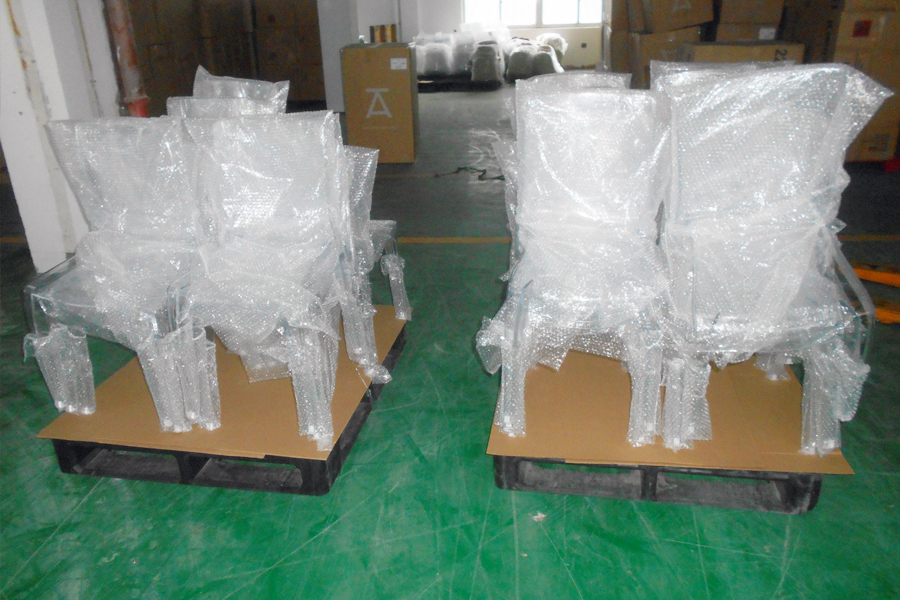
- Internal securement: Verify proper placement of EPE foam, bubble wrap, and cardboard corner protectors, with no movement of the product inside the carton
Furniture Inspection Quick Reference
| Inspection Dimension | Core Items | Acceptance Criteria | Key Risks |
|---|---|---|---|
| Visual & Dimensional | Paint finish, veneer, assembly, color difference, dimensional tolerance | AQL 2.5/4.0 sampling judgment | Batch color variation, loose assembly |
| Structural Strength | Static load, impact, fatigue durability, stability | BIFMA / EN 12520/12521 | Tip-over injury (leading cause of recalls) |
| Surface Treatment | Adhesion, hardness, color difference, veneer, hardware | ISO 2409 ≤ Grade 1, hardness ≥2H | Coating peeling, veneer blistering |
| Packaging & Transport | Drop, vibration, impact, stacking | ISTA 3A / 3B | Transport damage, post-delivery returns |
| Packaging Labeling | Shipping marks, warnings, barcodes, securement | Destination market regulatory requirements | Customs detention due to missing labeling |
Frequently Asked Questions
Q1. How much does furniture inspection cost? A1. Inspector Online charges per man-day, with rates starting at RMB 600 per inspector per day. Due to the large size of furniture and time required for handling and assembly, 2 inspectors are typically assigned. Projects involving structural and packaging testing may incur slightly higher fees. Local inspector deployment in furniture manufacturing hubs such as Foshan and Ningbo eliminates travel expenses.
Q2. What if a product fails the ASTM F2057 anti-tip test? A2. Anti-tip test failure is classified as a Critical (CR) defect, resulting in an immediate Failed verdict on the inspection report. Typical corrective actions include: thickening the back panel (≥9mm), including standard wall anchoring hardware (L-brackets or anti-tip straps), limiting maximum drawer extension, and adding counterweight to the cabinet base. Re-inspection is required after corrective actions are implemented, and shipment is only approved upon passing.
Q3. What is the sampling ratio for furniture inspection? A3. Sampling follows AQL standards. For a typical 50-unit order, 8 pieces are sampled; 20 pieces for 100 units; 50 pieces for 500 units. For Critical defects (CR, e.g., anti-tip failure), AQL 0 applies — meaning a single CR defect results in immediate rejection of the entire batch.
Q4. Can furniture ship if it fails the packaging drop test? A4. It depends on the root cause. If the failure stems from packaging design issues (e.g., too-thin cartons, missing corner protectors), shipment can proceed after packaging replacement and passing re-inspection. If the product itself is structurally fragile and cannot withstand normal drop impacts, product design modifications or additional cushioning packaging are required, with longer rework lead times. Pre-production packaging validation is recommended to avoid discovering issues after mass production.
Final Takeaway
The core of furniture inspection goes beyond surface appearance — it lies in structural testing, coating validation, and transport packaging protection. A single oversight in tip-over risk can lead to a full batch recall.
Inspector Online covers core furniture manufacturing hubs including Foshan, Ningbo, and Zhangzhou, with 30-minute response time and bilingual (Chinese/English) reports available in as fast as 4 hours. If you have a furniture order ready for shipment, or need guidance on structural testing and packaging solutions, feel free to contact Inspector Online for consultation.