One industry practitioner handled one of the costliest cases on record: a foreign trade firm shipped a full container of garments from Ningbo to Germany. When the container was unsealed at the Port of Hamburg, a long list of defects came to light—color deviation, size mismatches, loose threads and more. The buyer filed a direct claim for $180,000. That shipment had no pre-shipment inspection arranged.
Many first-time buyers of quality control services all ask the same question: what exactly does a third-party inspection company do? It may sound like a straightforward question, but those who ask it have usually already learned the hard way.
A quality inspection professional with 10 years of deep industry experience, who has visited over 300 factories across the Yangtze River Delta and Pearl River Delta, breaks down everything you need to know below: what third-party inspection firms oversee across the supply chain, when to use their services, and how to avoid costly pitfalls.

The Role of Third-Party Inspection Companies in the Supply Chain

Let’s start with the fundamentals.
A third-party inspection company serves as an independent quality adjudicator standing between buyers and manufacturers. Can you trust a factory’s in-house quality control team? For most importers, the answer is no. Can you fly overseas to supervise production yourself? The cost is prohibitive, and most buyers lack the specialized technical expertise. Third-party inspectors fill this exact gap.
Its independence is reflected in three key principles:
  1. It has no financial or operational ties to the factory, so findings are reported exactly as they are found.
  2. It maintains a pure service relationship with the buyer, not an agency relationship, and produces no biased conclusions for either party.
  3. The inspection report serves solely as a reference for the buyer’s shipment release decision.

Four Core Stages of Foreign Trade Inspection: What Problems Do They Solve?

Following the full order lifecycle, third-party inspection companies deliver four key types of services. The table below gives a full overview, with detailed explanations to follow.
Stage Timing Core Purpose Key Deliverable
Factory Audit Before formal cooperation Evaluate supplier qualifications and system capabilities Audit report with corrective action items
Initial Production Check When 10%–20% of production is completed Confirm production process and seal first-article samples Initial production inspection report
During Production Inspection When 50%–60% of production is completed Correct process deviations and intercept batch defects Mid-production inspection report
Pre-Shipment Inspection (PSI) 100% production completed, 80%+ packaged Final quality assessment before shipment PSI report (core deliverable)
Container Loading Supervision On the day of packing Supervise loading, verify quantity and seal integrity Loading supervision report + full-process photo documentation

第三方验货公司是做什么的

Factory Audit: Decide Whether to Partner With a Factory

A factory audit evaluates systemic capability, not the quality of a single batch. When inspectors arrive on site, the first thing they check is not the products themselves—but whether the factory has a formal quality manual, complete Incoming Quality Control (IQC) records, signed Outgoing Quality Control (OQC) procedures, and clear non-conforming product handling protocols. These details may sound tedious, but partnering with a factory that cannot even produce basic inspection records is a gamble.
Audits are benchmarked against the ISO 9001 framework, focusing on five modules: quality management system, production process control, incoming material inspection, finished goods inspection, and continuous improvement. Each module is scored to produce a final rating. For factories with excessively low scores, we advise clients against cooperation—the savings from skipping an audit are nothing compared to hundreds of thousands of dollars in future return losses.

Initial & Mid-Production Inspection: Stop Batch Defects Early

Many buyers skip these two steps, assuming a final pre-shipment check is enough. This is the most expensive misconception in the industry.
The initial production check takes place when 10%–20% of the order is in production. Its core goal is to confirm the production route is correct, first-article samples are properly sealed, and raw material batches match the client-approved specifications. In one case, an inspector conducting a footwear inspection in Quanzhou discovered the factory had replaced client-approved PU fabric with a domestic alternative. The color and hand feel were nearly identical, but wear resistance was a full grade lower. Catching this issue at the initial stage avoids full-batch rework later on.
The during-production inspection runs when 50%–60% of the order is complete, for the purpose of in-process correction. At this stage, defect patterns become consistent, making it the best window to identify systemic issues. For example, if skipped stitches appear across the entire sewing workshop, it is not a problem of individual worker skill—it is caused by incorrect machine tension settings. Catching this at the mid-production stage allows for quick parameter adjustments, saving the entire second half of the order.

Pre-Shipment Inspection (PSI): The Final Quality Defense Line

PSI is the final quality assessment conducted when 100% of production is finished and over 80% of goods are packaged. It is also the most frequently requested service in foreign trade inspection.
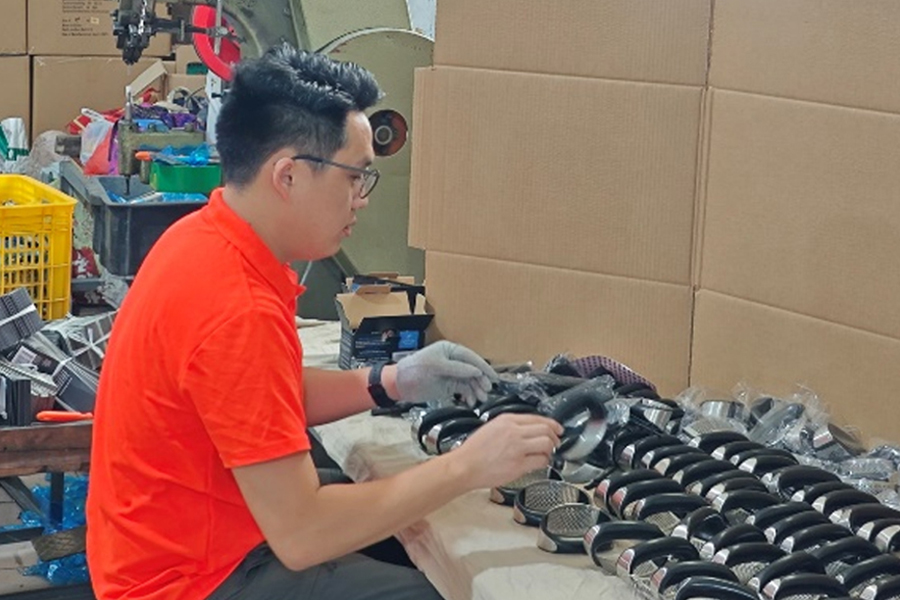
Sampling follows the Acceptable Quality Level (AQL) standard, based on GB/T 2828.1 (equivalent to MIL-STD-105E). The most widely used configuration is General Inspection Level II, with AQL 2.5 for major defects and AQL 4.0 for minor defects. For an order of 5,000 pieces, for example, the standard requires sampling 200 units. The acceptance number for major defects is 10, and the rejection number is 11. If 10 or fewer major defects are found, the lot is marked Passed; if the count exceeds 10, the lot is marked Failed.
Many buyers struggle to understand this section of the report, but the logic is straightforward: inspectors sample on site, check each item against a checklist, classify and count defects, then reference the AQL table to reach a verdict.

Container Loading Supervision: Prevent Risks in the Final Mile

Loading supervision takes place after a passing inspection, during the actual container packing stage. It may sound unnecessary, but countless incidents occur every year due to missing this step.
These are the four most common risks:
  1. Uninspected defective goods are secretly mixed into the container by factory staff after the inspector leaves.
  2. The packed quantity falls short, causing quantity discrepancies upon arrival at the destination port.
  3. Cargo is left unsecured and gets crushed entirely during rough ocean transit.
  4. Seal numbers do not match shipping documentation, leading to customs holds during clearance.
The standard loading supervision process follows four steps: verifying total quantity, supervising proper stowage, checking seal numbers, and documenting the full process with photos. Photos must be captured at four mandatory stages: empty container, half-loaded container, fully loaded container, and sealed container.

When You Must Use Third-Party Inspection, and When You Can Skip It

Not every order requires a full end-to-end inspection process. Use these practical guidelines:
  • First orders with new suppliers: Factory audit + initial production check + PSI are all mandatory to establish a clear quality baseline.
  • Mature products from long-term suppliers: Mid-production inspection + PSI is sufficient.
  • Small fast-turnaround orders (under 500 pieces): PSI alone is enough, as a full-process inspection would be cost-prohibitive.
  • High-value or high-risk categories (toys, home appliances, children’s products): Do not cut corners—arrange both PSI and loading supervision. A single quality incident can cost more than 10 inspection services combined.

How to Identify a Reliable Third-Party Inspection Company

Look for three hard indicators:
  1. Nationwide inspector coverage

    Companies that cover core industrial belts like the Yangtze River Delta and Pearl River Delta, and even extend to third- and fourth-tier production regions, can assign local inspectors to each job. This both reduces travel costs and guarantees faster response times, preventing shipment delays caused by long travel distances.

  2. Report turnaround speed

    The industry standard is 24–48 hours. Companies that deliver formal reports in 4 hours have highly streamlined workflows, typically supported by robust digital systems that deliver more consistent report quality.

  3. Report professionalism

    Bilingual (Chinese-English) reports are a basic requirement for foreign trade inspection. English reports must contain accurate defect descriptions, proper standard citations, and clear judgment logic. When overseas buyers use these reports to negotiate with factories, vague or imprecise wording directly erodes their negotiating leverage.

Frequently Asked Questions

Q1: How much do third-party inspection services typically cost?
Pricing is primarily based on man-days. Domestically, rates range from RMB 800 to RMB 2,000 per person per day, depending on product complexity, inspection location, and urgency. Local inspector assignment in industrial belts eliminates travel expenses, which is the biggest driver of price differences. Inspector Online offers services starting at RMB 600 per person per day, and also supports client-customized pricing.
Q2: What if the factory refuses to cooperate with the inspection?
This falls into two scenarios. If there is a formal purchase contract with explicit inspection clauses, the factory is legally obligated to cooperate. If the buyer did not include inspection terms in the contract, negotiation will be required. We recommend clarifying all inspection terms at the contract stage, including timing, inspection agency, acceptance standards, and report validity.
Q3: If inspection fails, can the goods still be shipped?
It depends on the severity and type of non-conformity. Exceeding the minor defect threshold usually allows for shipment after rework and re-inspection. If major or critical defects exceed the limit, full rework followed by re-inspection is recommended. The final shipping decision rests entirely with the buyer, but inspection companies clearly mark one of three conclusions on reports—Passed, Failed, or Pending—to support decision-making.
Q4: How long does a single inspection take?
It depends on order volume and product category. For a standard garment order under 5,000 pieces, on-site inspection takes half a day to one full day. Home appliance inspections require safety testing and usually take one full day. Complex product categories may take one to two days.
Foreign Trade Inspection
If you are working with a factory and unsure whether to arrange an inspection, or which type of inspection fits your order best, reach out to Inspector Online. With inspectors covering all major industrial belts across China, we offer 30-minute response times and deliver bilingual Chinese-English reports in as fast as 4 hours, stopping supply chain risks before your goods leave the factory.