
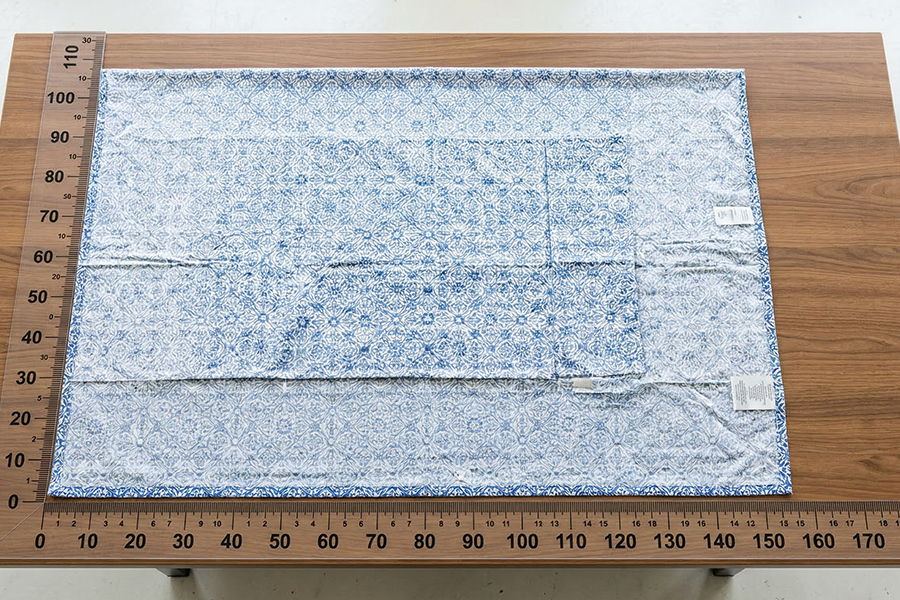
Fabric quality is the cornerstone of final product quality in textile trade and apparel manufacturing. More than 80% of cross-border sourcing orders worldwide adopt the fabric 4-point inspection system as the unified fabric grading standard. Defined under ASTM D5430, this quantitative system assigns penalty points to defects based on their size, enabling consistent, comparable quality assessment across suppliers and inspection teams. It is an essential skill for inspectors, QC staff and fabric suppliers alike.
1. What Is the Fabric 4-Point Inspection System?
The 4-point system is the most widely used visual defect grading method in the global textile industry. Its official standard is ASTM D5430 Standard Test Methods for Visually Inspecting and Grading Fabrics, published by ASTM International; the corresponding reference standard in China is GB/T 22846-2009.
The core principle is straightforward: defects on the fabric surface are assigned 1 to 4 penalty points according to their length or size — the larger and more impactful the defect, the higher the penalty. No single linear yard of fabric may receive more than 4 points, regardless of the number of defects present. Final quality is determined by the average penalty score per unit area.
In terms of scope, the 4-point system is highly versatile. It applies to woven fabrics, knitted fabrics, non-wovens, denim and most other textile categories, with only highly specialized fabrics such as lace and mesh requiring supplementary rules.
2. Core Penalty Rules of the 4-Point System
Penalty rules form the backbone of the system. All defects — whether running in the warp or weft direction — are graded by their length, according to the scale below:
| Defect Length (inches) | Penalty Points | Typical Defect Examples |
|---|---|---|
| ≤ 3 | 1 point | Small slubs, minor stains, single float stitch |
| > 3 and ≤ 6 | 2 points | Medium scratches, prominent coarse yarn, small snag |
| > 6 and ≤ 9 | 3 points | Long color streaks, long snags, minor selvedge damage |
| > 9 | 4 points | Continuous warp streaks, full-width filling bars, large-area color shading |
Beyond the basic grading scale, four special penalty rules apply — and they are the most common source of error in practice:
- Holes and punctures always score 4 points: Any hole, puncture or needle hole receives 4 points per occurrence, regardless of its diameter.
- Maximum 4 points per yard: No single linear yard may be assigned more than 4 total points, preventing localized defects from disproportionately penalizing an entire roll.
- Selvage exemption rule: Non-critical defects within 1 inch (approx. 2.54 cm) of the selvage may be exempted if they fall within the cutting waste margin and do not affect garment production.
- Continuous defects scored per yard: Full-width continuous defects such as filling bars, color shading, creases and skewing are penalized at 4 points per yard, rather than being counted as individual defects.
3. Complete Workflow for Fabric 4-Point Inspection
A standardized workflow is essential for reliable fabric 4-point inspection results. The full inspection process is divided into three phases — pre-inspection preparation, on-site inspection and final review — all conducted in compliance with ASTM D5430 environmental and operational requirements.
3.1 Pre-Inspection Preparation
- Environmental requirements: Inspection must be performed under D65 standard illuminant with a minimum illuminance of 750 lux, against a neutral gray background to avoid color distortion. Temperature and humidity should be kept at standard ambient levels to prevent fabric shrinkage or wrinkling.
- Document verification: Before starting, confirm the purchase order, approved quality sample and fabric specification sheet. Clarify the acceptance threshold, special defect exemptions and usable width requirements to avoid grading discrepancies.
- Equipment calibration: Set the inspection machine speed to no more than 15 yards per minute to allow adequate defect detection. Use a standard inch-scale ruler for consistent defect measurement.
3.2 On-Site Inspection Steps
- Mount the fabric roll on the inspection machine and adjust tension so the fabric lies flat, without over-stretching that could distort defects.
- Inspect yard by yard along the warp direction, with the fabric face as the primary inspection surface; critical orders require inspection of both face and back.
- Stop the machine immediately when a defect is found, measure its length, assign the corresponding points, and mark the location and score on the selvage with a marker.
- Scan the full width for weft defects, paying special attention to edge-to-center shading and filling bars; record any width deviations at the same time.
- After inspecting each roll, tally the total penalty points, total inspected yards and usable width, and keep a complete inspection record.
3.3 Inspection Notes
- Inspectors must have corrected vision of 1.0 or better, with normal color vision. A 10-minute break is recommended after every hour of continuous inspection.
- Suspected defects should be judged against the approved sample; inspectors should not subjectively upgrade or downgrade defect severity.
- Clusters of small defects from the same cause within a short length may be treated as a single continuous defect, to avoid double-counting.
4. Result Calculation and Quality Grading
Proper result calculation is the core of the fabric 4-point inspection system.The final inspection result is expressed as penalty points per 100 square yards, calculated using the industry-standard formula:
Points per 100 sq. yd. = (Total penalty points × 3600) ÷ (Fabric width in inches × Total inspected yards)
The constant 3600 is derived from the total square inches in 100 square yards. Always ensure width is measured in inches and length in yards — unit confusion is a common cause of incorrect results.
There is no universal mandatory acceptance threshold; limits are agreed between buyer and supplier based on fabric grade. Three common standards are:
- High-end / brand orders: ≤ 20 points per 100 sq. yd. — typically for women’s apparel, premium outdoor wear and similar categories.
- Standard trade orders: ≤ 25 points per 100 sq. yd. — the most widely accepted benchmark for general apparel orders.
- Entry-level / lining fabrics: ≤ 40 points per 100 sq. yd. — suitable for interlinings, packaging fabrics and other low-appearance-requirement applications.
For batch acceptance, a typical rule is “roll-level rejection + batch sampling”: a single roll exceeding the threshold is rejected individually; if the proportion of rejected rolls exceeds the agreed percentage (commonly 10%), the entire shipment may be rejected.
5. Common Defect Types and Scoring Examples
Fabric defects are generally categorized into warp defects, weft defects and surface defects, each with its own scoring logic. Below are common real-world examples:
- Warp defects: Broken ends, warp streaks, reed marks and color stripes running along the length of the fabric. Scored by actual length; continuous defects longer than 9 inches are penalized at 4 points per yard.
- Weft defects: Broken picks, filling bars, thin/thick places and crosswise stripes. Measured across the full fabric width; most full-width filling bars automatically score 4 points per yard.
- Surface defects: Holes, stains, pilling, float stitches and general weaving flaws. Scored individually by size; clusters of small stains may be measured as a combined length.
Calculation example: A fabric roll is 58 inches wide and 120 yards long, with a total of 28 penalty points recorded during inspection.
Formula: (28 × 3600) ÷ (58 × 120) ≈ 14.48 points per 100 sq. yd.
This result meets the 20-point threshold for high-end orders.
6. Common Pitfalls and Best Practices
Many QC disputes arise from misinterpretation of fabric 4-point inspection rules. Four common mistakes deserve special attention:
- Pitfall 1: Inspecting only the fabric face — Fabrics such as fleece and coated fabrics may have back-side defects that impact garment production. The standard does not limit inspection to the face only; always follow order requirements for double-sided inspection.
- Pitfall 2: Penalizing all selvage defects — Defects within 1 inch of the selvage that fall within the cutting waste margin are customarily exempted and do not need to be included in the total score.
- Pitfall 3: Counting continuous defects as individual flaws — Full-width continuous defects such as filling bars and color stripes should not be split into multiple small defects. They are scored at 4 points per yard.
- Pitfall 4: Incorrect unit conversion for width — The formula requires width in inches. Using centimeters by mistake will skew the result by a factor of 2.54, directly changing the pass/fail outcome.
7. 4-Point System vs. 10-Point System: A Comparison
Besides the 4-point system, the textile industry also uses a 10-point inspection system. The two differ notably in application:
- Regional adoption: The 4-point system is an American standard, dominant in North American and Southeast Asian trade orders; the 10-point system is more commonly specified by European buyers.
- Stringency: The 10-point system is more sensitive to minor defects with finer grading; the 4-point system has simpler rules, fewer disputes and much wider global adoption.
- Recommendation: Unless a customer explicitly specifies otherwise, the 4-point system is preferred for export orders — it offers broader compatibility and lower alignment costs between parties.
8. Summary and Practical Recommendations
Consistent implementation of the fabric 4-point inspection system protects both buyers and suppliers. The 4-point system has become the global default for fabric inspection because it is quantitative, simple to apply and highly repeatable, greatly reducing quality communication costs between buyers and suppliers.
Mastering the rules is only the foundation. To consistently control fabric quality, companies should also: first, standardize grading criteria among internal inspectors with regular calibration exercises; second, retain complete inspection records and defect samples as evidence for dispute resolution; and third, for high-value orders, engage an independent third-party inspection company for neutral assessment to avoid internal bias.
Fabric quality control is the first checkpoint in order fulfillment. Proper implementation of the 4-point inspection system effectively reduces defect rates in downstream garment production and mitigates quality risks at the source.